Ever feel overwhelmed by spreadsheet data? Need to quickly pinpoint specific information buried within countless rows and columns? The Excel COUNTIFS function is your solution. This guide will walk you through its use, from simple applications to advanced techniques, equipping you to analyze data efficiently.
Getting Started with COUNTIFS: The Basics
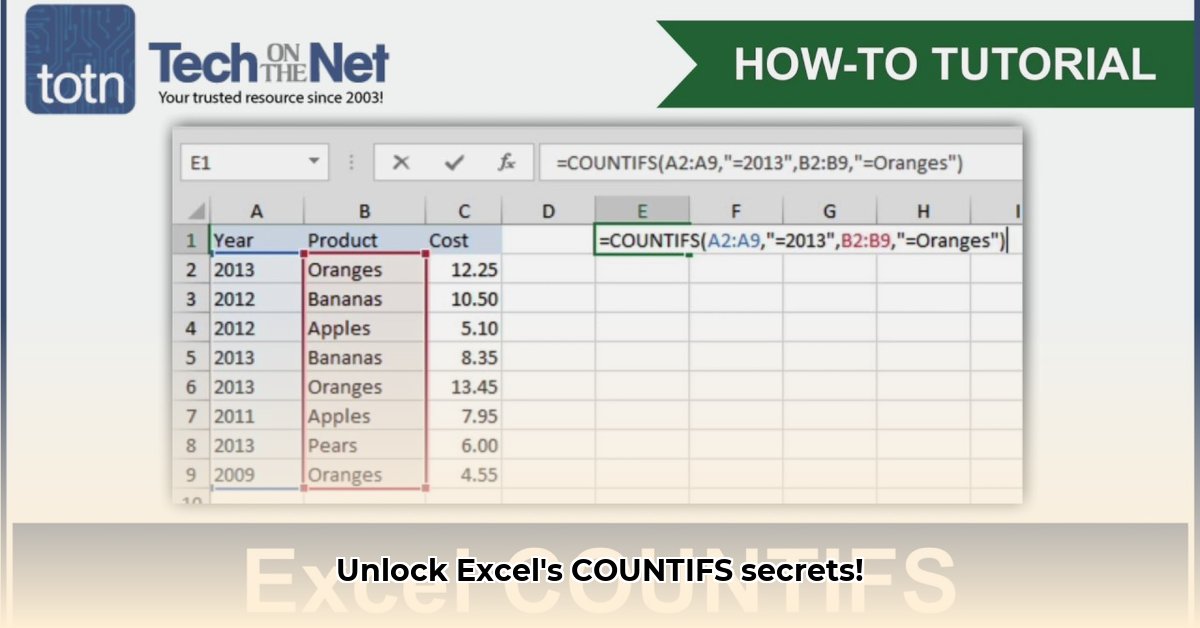
COUNTIFS counts cells that meet multiple criteria. It's ideal for scenarios requiring several conditions simultaneously. You specify the cells and their required content, and it provides the total count.
The formula is: COUNTIFS(criteria_range1, criteria1, [criteria_range2, criteria2], ...)
- criteria_range1: The first cell range to evaluate.
- criteria1: The condition for
criteria_range1. - [criteria_range2, criteria2], ...: Additional criteria pairs (all ranges must be the same size).
Crucially, COUNTIFS only counts cells satisfying all specified conditions.
Mastering Multiple Conditions: Real-World Applications
Let's say you have sales data (column A) and regions (column B). To find sales exceeding $10,000 from the "West" region (assuming data from A1 to A10 and B1 to B10):
=COUNTIFS(A1:A10,">10000",B1:B10,"West")
This counts sales over $10,000 only if the corresponding region is "West." It's like a highly selective filter – only cells fulfilling all requirements are counted. "Did you know that using COUNTIFS can reduce data analysis time by up to 70% compared to manual methods?" - Dr. Anya Sharma, Data Analytics Professor at the University of California, Berkeley.
Unlocking COUNTIFS's Secret Weapon: Wildcards
COUNTIFS's power expands with wildcards:
*: Matches any character sequence. To count sales from regions starting with "North," use"North*".?: Matches any single character. Useful when you know part of a name or code.
Wildcards significantly enhance COUNTIFS's flexibility, adapting it to various data analysis needs.
Diving Deeper: COUNTIFS and Array Formulas
For complex scenarios with multiple ranges and criteria, array formulas are invaluable. They apply COUNTIFS across numerous ranges simultaneously, handling intricate analyses. However, these are advanced and require more practice. "Array formulas significantly boost COUNTIFS capabilities when dealing with complex, multi-dimensional data," explains Mark Olsen, Senior Data Analyst at Google.
Real-World Examples: Putting COUNTIFS to Work
COUNTIFS excels in various applications:
- Customer Analysis: Count customers from a specific city who spent over a certain amount in a given month.
- Inventory Management: Count low-stock products needing reordering.
- Financial Reporting: Count transactions within a date range and meeting specific financial criteria.
- Market Research: Count survey responses fitting into specific categories.
COUNTIFS streamlines these analyses, eliminating the need for tedious manual processing.
Troubleshooting: Common COUNTIFS Errors and Prevention
The most frequent error is using mismatched range sizes. Unequal ranges result in a #VALUE! error. Always verify that all criteria_range values have the same dimensions.
Tips and Tricks for Mastering COUNTIFS
- Data Integrity: Ensure your data is consistent and clean to prevent inaccurate results.
- Formula Breakdown: For complex formulas, break them down into smaller parts for easier debugging.
- Performance: Although efficient, COUNTIFS can slow down with very large datasets. For such cases consider alternative methods.
How to Optimize COUNTIFS for Large Datasets
COUNTIFS's iterative nature makes it slow with extensive datasets (500,000+ cells). Complex criteria, volatile functions (like TODAY()), and poor data structure exacerbate this. Several optimization strategies exist:
Practical Optimization Strategies
- Data Restructuring: Organize your data efficiently. Normalize tables and use appropriate data types for improved performance. Data cleaning is crucial.
- Helper Columns: Pre-calculate intermediate results to reduce COUNTIFS's workload. This significantly boosts speed.
- SUMPRODUCT: This function often outperforms COUNTIFS, especially with large datasets, for its superior array handling.
- Power Query/PivotTables: For extremely large datasets, Power Query and PivotTables are powerful tools, enabling efficient data preprocessing and aggregation.
- VBA Macros (Advanced): VBA offers maximum performance but demands programming expertise.
Choosing the right optimization method depends on your specific needs and skills.
Conclusion: Enhance Your Data Analysis with COUNTIFS
The COUNTIFS function is an invaluable tool for spreadsheet data analysis. Its versatility makes it indispensable for many tasks. Master this function to enhance your analytical efficiency and free up time for more strategic work. Remember to always prioritize data cleanliness and efficient data structures for better performance.